Weed Control J 2024; 23: e202400857
Addition of ammonium sulfate to glyphosate in the desiccation of Urochloa brizantha cv. BRS “Piatã”
DOI: 10.7824/wcj.2024;23:00857
Abstract:
Background:
Glyphosate is the most widely used herbicide in Brazilian agriculture, and management techniques that increase its efficacy are important tools for the production system.
Objective:
Evaluate the effect of adding the nitrogen adjuvant ammonium sulfate [(NH4)2 SO4] to glyphosate on the control of Urochloa brizantha BRS Piatã and establish the best [(NH4)2 SO4] dose to mix with the herbicide.
Methods:
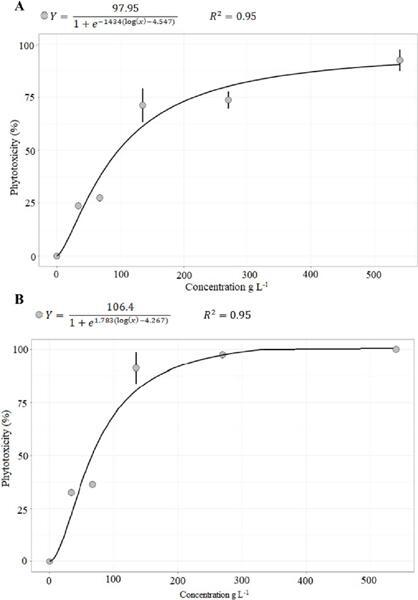
Two greenhouse experiments were conducted. In the first, six glyphosate doses (0; 33.75; 67.5; 135; 270; 540 g a.e. ha-1) were used to determine C80 (glyphosate dose that achieved 80% control). This dose was used as a reference for the second experiment in a mixture with four [(NH4)2 SO4] doses (0; 6.67; 13.33; and 20 g L-1 of solution) to determine the best nitrogen dose. Both experiments assessed BRS Piatã grass control at 7, 14, and 21 days after treatment (DAT) and shoot length and dry weight at 21 DAT.
Results:
The C80 of glyphosate was established at 270 g a.e ha-1. The visual scale indicated that adding [(NH4)2 SO4] accelerated the glyphosate-related symptoms but did not change plant fresh and dry weight and shoot length. Maximum glyphosate efficacy was obtained by adding ammonium sulfate at 16.2 g L-1 of solution.
Conclusions:
Ammonium sulfate accelerates the glyphosate action in the desiccation of Urochloa brizantha BRS Piatã.
Keywords: brachiaria; herbicide; no-till; sustainability; weeds
186