Weed Control J 2025; 24: e202500880
Performance of herbicide mixtures and sequential application for benghal dayflower management
DOI: 10.7824/wcj.2025;24:00880
Abstract:
Background:
Benghal dayflower is a weed widely distributed in Brazil, known for its tolerance to glyphosate, requiring the use of alternative herbicides and more complex control strategies.
Objective:
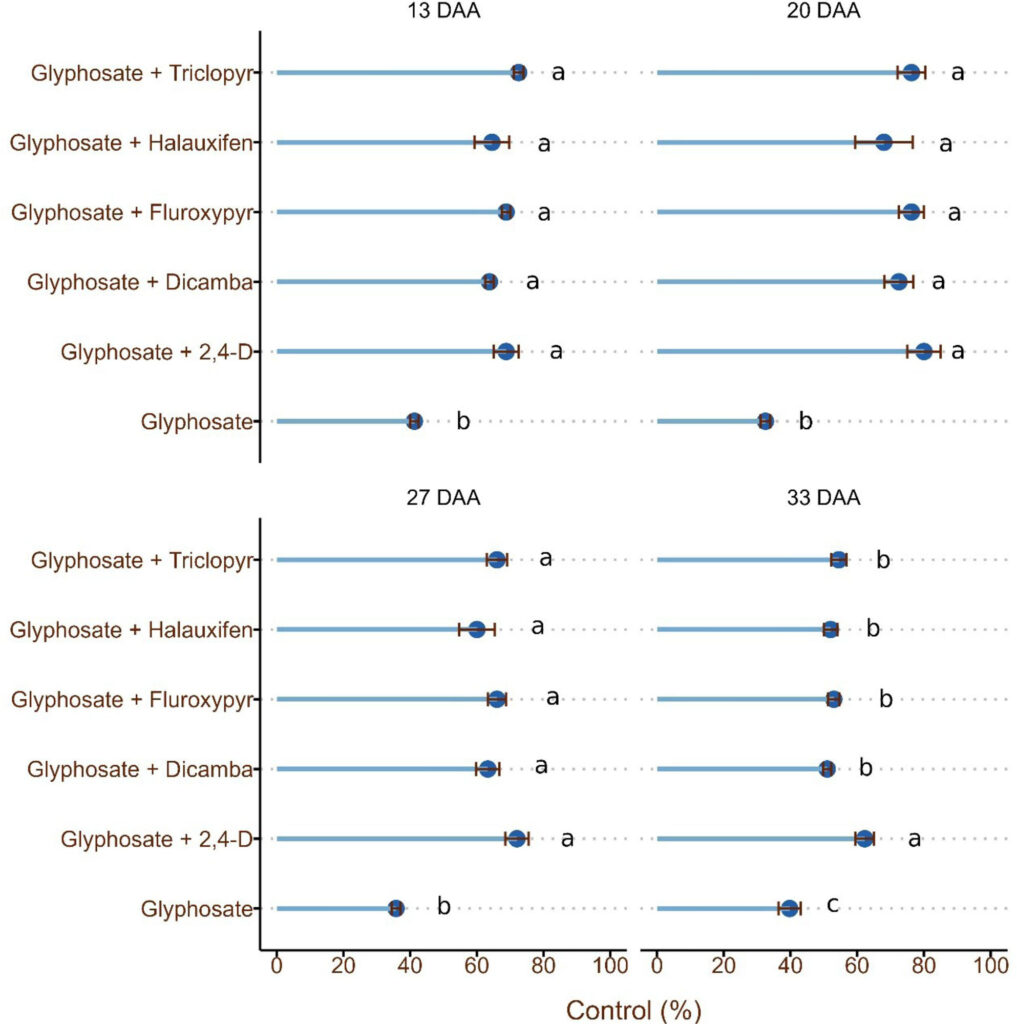
Evaluate different auxinic herbicides in combination with glyphosate for the control of Benghal dayflower and assess the efficacy of glufosinate alone or in combination with PPO inhibitors in sequential applications.
Methods:
Two experiments were conducted in Ponta Grossa (PR-Brazil), using a randomized block design. The first experiment evaluated different auxinic herbicides combined with glyphosate, including 2,4-D, triclopyr, halauxifen, fluroxypyr, and dicamba. Additionally, treatments with glyphosate alone and a non-treated control were assessed. The second experiment evaluated Benghal dayflower control with glyphosate + 2,4-D followed by sequential glufosinate applications alone or with PPO inhibitors, including saflufenacil, tiafenacil, carfentrazone, and flumioxazin. In both experiments, visual weed control evaluation were performed by means of control percentage relative in comparison of untreated control.
Results:
Glyphosate plus auxinic herbicides showed better control level compared to glyphosate alone, especially for 2,4-D + glyphosate mixture. The addition of PPO inhibitors did not improve Benghal dayflower control compared to glufosinate alone. However, sequential applications enhanced control, achieving an average of approximately 93% compared to only 75% in the non-sequential treatment.
Conclusions:
The use of auxinic herbicides in mixture with glyphosate, mainly 2,4-D, in the burndown application and sequential treatment of glufosinate alone or combined with PPO inhibitors are strategies that enhance Benghal dayflower control.
155