Weed Control J 2025; 24: e202500851
Tolerance of tifton 85 and jiggs (Cynodon dactylon L.) to post-emergent herbicides
DOI: 10.7824/wcj.2025;24:00851
Abstract:
Background:
The genus Cynodon has great forage potential, but the management of its cultivars in Brazilian growing conditions is scarce.
Objective:
The objective was to evaluate the tolerance of Tifton 85 and Jiggs to different herbicides at post-emergence.
Methods:
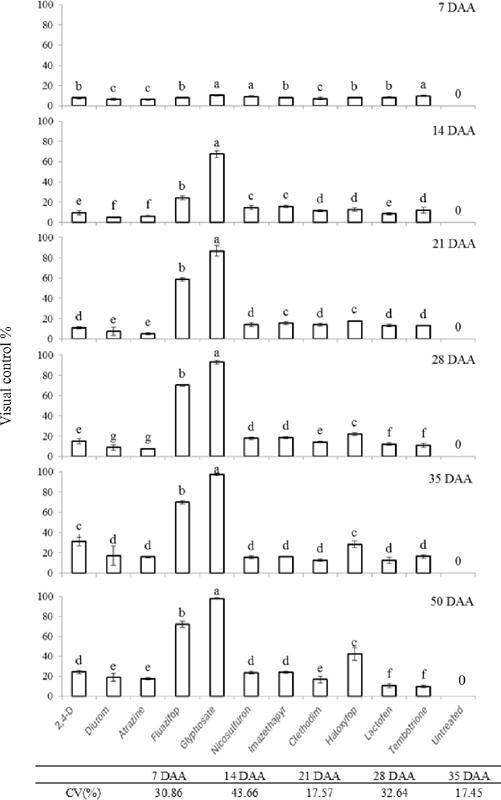
The experiment was carried out in pots in a greenhouse. Two experiments were carried out, with Tifton 85 and Jiggs forages using twelve treatments, eleven herbicides (2,4-D, diuron, atrazine, fluazifop-p-butyl, glyphosate, nicosulfuron, imazethapyr, clethodim, haloxyfop-p-methyl, lactofem, tembotrione) and a control without the application. The herbicides injury were evaluated at 7, 14, 21, 28, 35 and 50 days after application (DAA), the index of chlorophyll a and b and the regrowth capacity of forage plants 60 days after cutting.
Results:
From 14 DAA, the herbicide glyphosate, followed by fluazifop-p-butyl, showed high herbicide injury to both grasses and with a significant reduction in the chlorophyll index of the Tifton 85 plants. The forages treated with glyphosate did not show regrowth 60 days after cutting.
Conclusions:
Tembotrione had no influence on regrowth of Tifton 85. 2,4-D, atrazine, clethodim and lactofem had no negative effect on regrowth of Jiggs 60 days after cutting, indicating good strategies in the chemical management of weeds in Tifton 85 and Jiggs pastures, respectively.
Keywords: chemical control; forages; herbicide injury; pasture management
288